


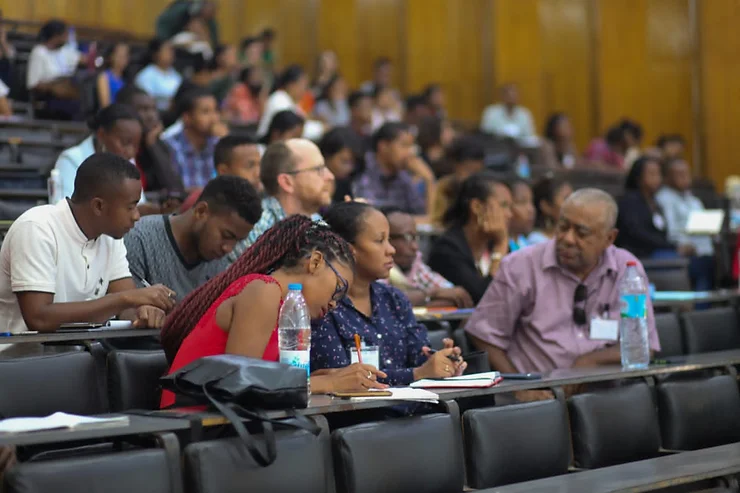
The fifth edition of the Tany Vao (“new land” in Malagasy) Summer University in Social Sciences in West Africa and Madagascar was held from October 24 to November 2, 2022. It began in Antananarivo with a day and a half of plenary lectures, followed by a round-table discussion. It continued in Toliara with methodological workshops closely combining theory and practice, involving participants in mini-projects on which they worked intensively for five days. The four workshops dealt respectively with: environment, socio-economic development and the SDGs; impact assessments and protected areas; interdisciplinary ethnoecology to address nature-society interactions; anthropological and historical approaches to human-environment relations.
The fruit of a close, long-standing partnership, the event was co-organized by the University of Antananarivo, the University of Toliara and the Institut de recherche pour le développement (IRD); with six Unités mixtes de recherche (UMR) and Unités mixtes internationales (UMI) involved (LEDa-DIAL, PALOC, SENS, SOURCE, IMAF, Espace-Dev) as well as the Malagasy Dinika sy Ainga analysis and training center. Tany Vao 2022 also drew on multiple collaborations and contributions from various institutions, including the Agence française de développement (AFD), which has supported this training program since its inception (through the PAIRES project), the French Embassy in Madagascar, Global Africa, the Centre national de la recherche scientifique (CNRS), Western University and the Social Sciences and Humanities Research Council (SSHRC-CRSH) in Canada, and various French universities (Université Paris-1, Université de Lille, Université Paris-Dauphine).
Tany Vao’ s originality lies in its ambitious multi-disciplinary approach, combining the contributions of different methodological approaches in the social sciences around a central theme. This year’s Université d’été enabled the 100 selected candidates (PhD students, Master’s students, young researchers and interested professionals) to perfect their methodological and analytical skills on the theme of “Environment and Society”. They familiarized themselves with concepts, approaches and research methods from different disciplines. In particular, the workshops provided an opportunity to work on different modes of data collection, both qualitative and quantitative, on people’s perceptions of environmental problems, on the possible trade-off between socio-economic needs and the issue of conservation, on representations, on local knowledge, practices and standards, on the diversity of resources, on planned actions, etc. One workshop focused on assessment tools and associated issues. Based on a concrete case study of the impact of protected areas on the loss of tree cover, participants were introduced to assessment methods and asked about their respective advantages and limitations.
More broadly, Tany Vao is also an opportunity to network young researchers from a variety of disciplines and backgrounds (geographers, sociologists, historians, ecologists, anthropologists, agronomists, jurists, economists, etc.), thus sparking collective dynamics and fostering interdisciplinary and intercultural dialogues. At the end of this edition, the one hundred participants from different institutional backgrounds and different regions of Madagascar will join the community of young Tany Vao graduates (they were 50 in 2016, 90 in 2018, 100 in 2019, and 25 in 2021 during the relay edition, distanciel in a pandemic context). Given that some of them have participated in several editions, this community now includes just over 350 doctoral students and young researchers from Madagascar and West Africa, as well as around 100 trainers.The fruit of a close, long-standing partnership, the event was co-organized by the University of Antananarivo, the University of Toliara and the Institut de recherche pour le développement (IRD); with six Mixed Research Units (UMR) and International Mixed Units (UMI) involved (LEDa-DIAL, PALOC, SENS, SOURCE, IMAF, Espace-Dev) as well as the Malagasy analysis and training center Dinika sy Ainga. Tany Vao 2022 also drew on multiple collaborations and contributions from various institutions, including the Agence française de développement (AFD), which has supported this training program since its inception (through the PAIRES project), the French Embassy in Madagascar, Global Africa, the Centre national de la recherche scientifique (CNRS), Western University and the Social Sciences and Humanities Research Council (SSHRC-CRSH) in Canada, and various French universities (Université Paris-1, Université de Lille, Université Paris-Dauphine).
Tany Vao’ s originality lies in its ambitious multi-disciplinary approach, combining the contributions of different methodological approaches in the social sciences around a central theme. This year’s Université d’été enabled the 100 selected candidates (PhD students, Master’s students, young researchers and interested professionals) to perfect their methodological and analytical skills on the theme of “Environment and Society”. They familiarized themselves with concepts, approaches and research methods from different disciplines. In particular, the workshops provided an opportunity to work on different modes of data collection, both qualitative and quantitative, on people’s perceptions of environmental problems, on the possible trade-off between socio-economic needs and the issue of conservation, on representations, on local knowledge, practices and standards, on the diversity of resources, on planned actions, etc. One workshop focused on assessment tools and associated issues. Based on a concrete case study of the impact of protected areas on the loss of tree cover, participants were introduced to assessment methods and asked about their respective advantages and limitations.
More broadly, Tany Vao is also an opportunity to network young researchers from a variety of disciplines and backgrounds (geographers, sociologists, historians, ecologists, anthropologists, agronomists, jurists, economists, etc.), sparking collective dynamics and fostering interdisciplinary and intercultural dialogues. At the end of this edition, the one hundred participants from different institutional backgrounds and different regions of Madagascar will join the community of young Tany Vao graduates (they were 50 in 2016, 90 in 2018, 100 in 2019, and 25 in 2021 during the relay edition, distanciel in a pandemic context). Given that some of them have participated in several editions, this community now includes just over 350 doctoral students and young researchers from Madagascar and West Africa, as well as around 100 trainers.