


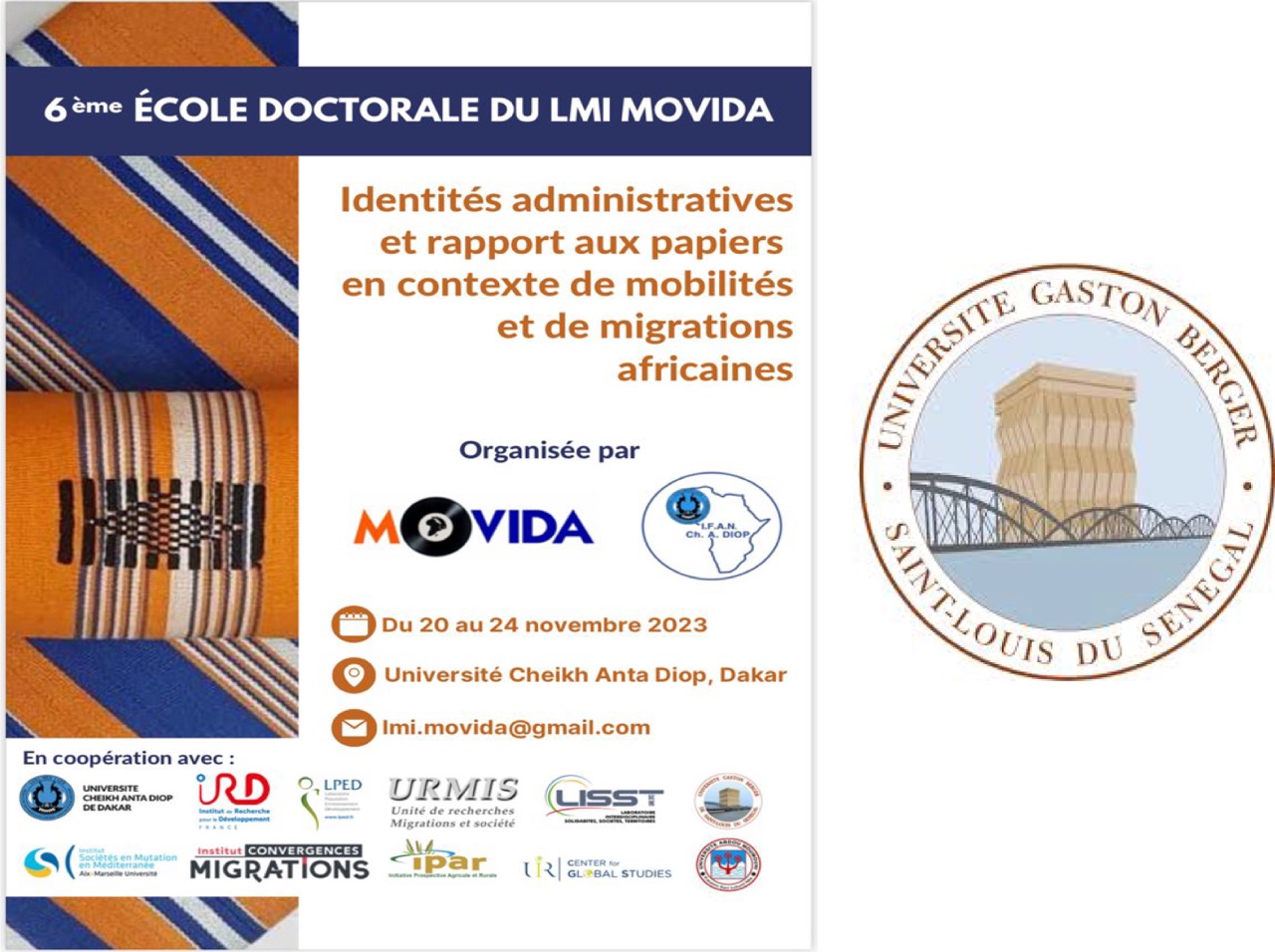
November 20 to 24, 2023
Cheikh Anta Diop University, Dakar
Organized by
the Institut fondamental d’Afrique noire (IFAN) of the Université Cheikh Anta Diop (UCAD) and the Institut de Recherche pour le Développement (IRD)
With the support
of IRD’s Laboratoire Population Environnement Développement (LPED), Aix-Marseille University’s Institut Sociétés en Mutation en Méditerranée (SoMuM) and the Institut Convergences Migrations (ICM).
The aim of this school is to stimulate reflection and exchange on the question of administrative identities and the relationship to documentation in research on migration and mobility. The school also aims to enable participants to carry out fieldwork and observation on this theme, and to learn how to use it in their writing.
Sales pitch
African mobilities, which are at the heart of the MOVIDA (Mobilités, Voyages, Innovations et Dynamiques dans les Afriques méditerranéenne et subsaharienne – Mobilities, Travel, Innovation and Dynamics in Mediterranean and Sub-Saharan Africa) International Joint Research Laboratory, combine two types of preconceived ideas: on the one hand, mobilities and migrations are not very dependent on their formal frameworks; on the other, Africa is not very governed by written rules and formalization procedures. In reality, in Africa as elsewhere, titles and documents influence the way in which mobility and migration take place and are experienced. On the continent, difficulties in accessing administrative procedures and documents, as well as a lack of respect, at times, for the papers obtained or presented, coexist with an influential bureaucracy and administrative rigidity. Thus, in parallel with and seemingly as a paradox of the informality that seems to predominate in various respects concerning intra-African migration (circulation, work, etc.), administrative formalities and papers take on an important place in life paths and belonging. This reality is reinforced in the context of the legalization of migration that has marked the last twenty years, including in Mediterranean and West Africa.
This school proposes to work on the link between migratory routes and administrative identities. In a world where the written word has become widespread at state level, every individual is subject to administrative markers that serve to identify, categorize, classify and account for him or her. For people crossing borders or living outside their country of nationality, administrative papers can take on particular importance. Whether or not they recognize themselves in the administrative identities assigned to them, whether or not they accept formal categorizations, these people are confronted with the question of the papers that translate them, designate them and regularly influence their migratory paths. This theme will serve as an anchor for the implementation of field experiments and scientific writing workshops.
This doctoral school first invites us to reflect on the relevance of taking into account documentation-related issues in the understanding of mobility and migration by various disciplines (history, sociology, anthropology, geography, philosophy, political science, demography, law, etc.). The administrative situation of people on the move generally leads to their categorization (national/foreign; regular/irregular; refugee/migrant, etc.) and guides others’ perception of their belonging and values. Documents can be identity markers (family, national, religious, intellectual, etc.). They can prove a right. They can also betray or exclude. The absence of documents can mean the absence of protection, or open up opportunities. Generally speaking, we’ll be thinking about the use of papers (official or unofficial documents, archives, “paperwork”) in our research materials: how do we apprehend them? What legitimacy do they have? How can we integrate them into our analyses? What stories do they tell that narratives of migratory journeys do not – or do not tell in the same way?
Over time, foreigners/migrants can have different administrative statuses, giving them different rights. They may go through periods of irregularity and obtain another nationality. The complexity of administrative procedures and their impact on the lives of migrants and their families will be explored. The school invites us to explore the variety of statuses and the diversity of data and administrative formalities likely to have an impact on the lives and journeys of migrants (passports, visas, residence permits, refugee certificates, marriage certificates, ijâza, etc.). It will also lead to a discussion of the multiple forms of relationship to these data and formalities (formalism, indifference, discreet categorizations, destruction of documents, etc.).
From both a historical and comparative perspective, the school invites us to re-examine administrative and legal affiliations from a new angle. Behind the technicality of the documentation and the simplicity of the formalism lurks a set of major questions touching on individual identities and collective affiliations, national constructions, decolonization and (West) African unity in particular.
Mobilizing a wide range of skills, the doctoral school will feature lectures, debates and doctoral workshops linked to field writing and data collection.
- Doctoral workshops
The 6th edition of the doctoral school is once again an opportunity for LMI MOVIDA doctoral students, as well as those affiliated with its scientific partners, to meet and discuss methodological and epistemological issues, as well as more personal questions relating to their research on migration issues and, in particular, relationships with documents. The doctoral workshops will be run in small groups over several half-days by researchers associated with the LMI MOVIDA, and a feedback session will be organized at the end of the week.
- Practical workshops
The doctoral workshops will include round-table discussions and “field writing” workshops. One day will be devoted to surveys and data collection in Dakar, in a field of one’s choice involving mobilities and relationship to papers, followed by a day devoted to the restitution of field surveys and discussion of written reports.
Conditions of participation
This training school is designed to welcome doctoral students working on migration issues, particularly from, to and through Africa. Priority will be given to doctoral students from UCAD and the UGB of St Louis, as well as to doctoral students who are members of LMI MOVIDA.
Candidates are required to send their CV (one page maximum) and a letter of application (motivation, interest in this type of exercise and possible link between the subject and the thesis) to lmi.movida@gmail.comby June 28, 2023 at the latest. The subject of the e-mail should be “Application for MOVIDA Training School”.
Organizing Committee
- Cheikh El Hadji Abdoulaye Niang, IFAN/UCAD
- Sophie Bava, IRD/LPED
- Marie-Laurence Flahaux, IRD/LPED
- Saliou Ngom, IFAN/UCAD
- Delphine Perrin, IRD/LPED
- Seydi Diamil Niane, IFAN/UCAD
Scientific Committee
- Cheikh El Hadji Abdoulaye Niang, IFAN/UCAD
- Sophie Bava, IRD/LPED
- Florence Boyer, IRD/URMIS
- Cheikh Oumar Bâ, IPAR
- Mamadou Dimé, UGB/ULRIC
- Marie-Laurence Flahaux, IRD/LPED
- Nadia Khrouz, UIR/CGS
- Stéphanie Lima, INUC Albi, LISST Toulouse
- Harouna Mounkaïla, Université Abdou Moumouni/GERMES
- Saliou Ngom, IFAN/UCAD
- Marème Niang-Ndiaye, Dpt de Géographie/UCAD
- Delphine Perrin, IRD/ LPED
- Seydi Diamil Niane, UCAD/ IFAN
- Emeline Zougbede, ICM
Downloads
In collaboration with
